

Best eSIM for Vietnam (2026): Plans, Prices and Local SIM Compared
Get trifa and enjoy internet connectivity wherever you go
Only 3 minutes for setup!Get trifa App for FREE!

CHAT BOT
Ask for inquiries about use
Vietnam is one of the cheapest places in Asia to get mobile data, and one of the countries where you will miss it most if you do not. Grab is how you move around Hanoi and Ho Chi Minh City, addresses are hard to find without a live map, and most small tour operators confirm over a messaging app rather than email. There are four ways to stay online: an international travel eSIM, a local prepaid SIM, a rented pocket Wi-Fi, or your home carrier's roaming pass. For most short-stay visitors the eSIM now wins on every axis that matters, and the price gap against roaming is large enough that it is not really a close call. This guide compares six eSIM providers for Vietnam with prices checked on each provider's own site, explains which of the three Vietnamese networks your plan will actually run on, and covers the passport registration rule that catches travelers out at the airport SIM counters.
Table of Contents
Why Use an eSIM in Vietnam?

Vietnam is an unusually connectivity-dependent country to travel in. Grab is the default way to move around Hanoi and Ho Chi Minh City, addresses are hard to find without a live map, menus often need a camera translation, and most of the small operators you will book with — sleeper buses, Ha Long Bay boats, motorbike tours — confirm over Zalo, WhatsApp or Messenger rather than email.
You are connected the moment you clear immigration
An eSIM is a mobile plan you download to your phone instead of a card you slot into it. You buy it, install the profile over Wi-Fi before you fly, and switch it on when you land — no arrivals queue, no passport to hand over at 1 a.m., no risk of finding the counter closed. That matters in Vietnam, where many long-haul arrivals land late at night.
It is cheap, and it keeps your home number alive
Vietnam is one of the cheaper eSIM markets in Asia. Entry-level plans from the major international providers start around US$4 — Airalo lists Vietnam from $4.00, Saily from US$3.99 and Nomad from US$4 [Source: Airalo, Saily and Nomad official product pages, accessed 2026-08]. That is roughly a third of what a single day of carrier roaming costs.
An eSIM also sits alongside your existing SIM rather than replacing it. Your home number stays reachable for two-factor codes, bank alerts and the airline's rebooking text while your data runs over the Vietnamese network. With a physical local SIM, your home SIM comes out and rides around in your wallet for two weeks.
Related reading: What is an international eSIM? How it compares with pocket Wi-Fi and roaming
The Best eSIMs for Vietnam, Compared (2026 Prices)
Six providers are worth considering for Vietnam: Trifa, Airalo, Saily, Holafly, Nomad and Klook. Every figure below was checked on the provider's own website on 15 August 2026.
One caveat first: all of these providers price by region, so your checkout price in the US, Australia or the UK can differ from someone else's. Where a full plan-by-plan list was not published in US dollars, the table gives the provider's own starting price rather than a number copied from a comparison site. Rank with the entry prices, then confirm the exact plan in the provider's app.
Quick picks by trip length
- A long weekend, light use. A 1–3 GB plan covers maps, messaging and ride-hailing. Saily and Airalo both start under $5.
- One to two weeks, normal use. A 5–10 GB plan over 15–30 days is the sweet spot. Trifa's tiers run 1 GB to 80 GB across 3 to 60 days, so you can match the plan to the trip instead of rounding up.
- Heavy use, streaming or remote work. Go unlimited. Holafly's entire Vietnam range is unlimited and priced openly in US dollars — $11.90 for 3 days to $73.90 for 30 days [Source: Holafly official, accessed 2026-08].
- Continuing to Thailand, Cambodia or Laos. Buy a regional or subscription plan instead of stacking single-country eSIMs.
The six providers side by side
Provider | Vietnam plans from (USD) | Unlimited option | Local network | Hotspot / tethering |
|---|---|---|---|---|
Trifa | Check current plans in the app | Yes | Local networks (not published) | Depends on plan |
Airalo | $4.00 | Yes | VNPT (5G) | Not published |
Saily | $3.99 | Yes | Not published | Yes, no hotspot restrictions |
Holafly | $11.90 (3 days) | Yes — every plan | GPC VinaPhone (VNPT) | Yes, capped at 1 GB per day |
Nomad | $4.00 | Yes | Vietnamobile, MobiFone or VinaPhone (switchable) | Yes |
Klook | Varies by package | Yes | Viettel (5G) | Depends on package |
[Sources: each provider's official Vietnam product page, accessed 2026-08. "Not published" means the provider does not state it on its Vietnam page — it is not a "no".]
What each provider is good at
Trifa is a Japan-headquartered eSIM app covering 200 countries and regions. Its edge in Vietnam is granularity: eight data tiers from 1 GB to 80 GB plus unlimited, across 3 to 60 days, so you rarely buy more than you need.
Airalo is the largest eSIM marketplace and the safest default if you have never used one. Its Vietnam eSIM runs on VNPT, is listed as a 5G product, and starts at $4.00.
Saily is the cheapest entry point at US$3.99. Its Vietnam range runs from 1 GB to unlimited, all plans carry a 30-day activation window — useful if you buy weeks ahead — and Saily explicitly states there are no hotspot restrictions, which not every provider does.
Holafly sells nothing but unlimited data for Vietnam, which makes it the simplest choice if you would rather not think about gigabytes. Two trade-offs: hotspot sharing is capped at 1 GB per day, and a fair-usage policy can slow your speed for up to a day at a time before resetting.
Duration | USD | AUD (approx.) | GBP (approx.) |
|---|---|---|---|
3 days | $11.90 | A$16.90 | £8.80 |
5 days | $20.50 | A$29.10 | £15.20 |
7 days | $27.50 | A$39.10 | £20.40 |
10 days | $36.50 | A$51.80 | £27.00 |
15 days | $50.50 | A$71.70 | £37.40 |
30 days | $73.90 | A$104.90 | £54.70 |
AUD and GBP are converted at roughly A$1.42 and £0.74 to the US dollar, the mid-August 2026 range. Holafly bills in US dollars, so your card issuer's rate applies. [Source: Holafly official, accessed 2026-08]
Nomad is the pick if network flexibility matters. Its Vietnam eSIM can be switched between Vietnamobile, MobiFone and VinaPhone from your phone's settings — a useful hedge if one network is weak where you are staying. Tethering is supported, and once the day's high-speed allowance is used the connection throttles to 512 kbps rather than cutting off. Plans start at US$4.
Klook is worth a look for one reason: its Vietnam eSIM is sold as a 5G product on Viettel, which none of the other five publish. If your itinerary runs well outside the major cities, that is the most direct way onto Viettel without walking into a Vietnamese shop. Pricing varies by package.
Vietnam's Mobile Networks: Viettel, VinaPhone and MobiFone
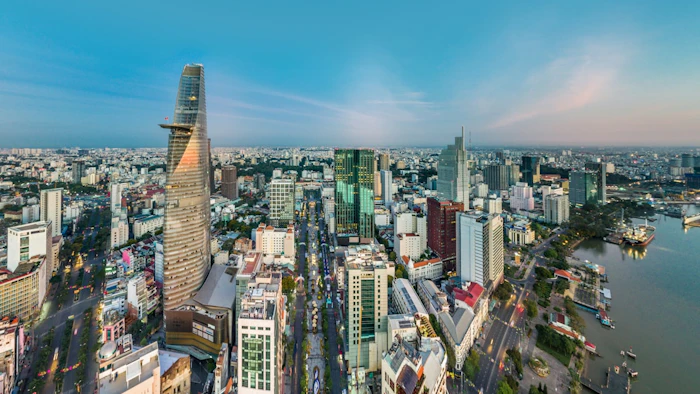
Whichever eSIM you buy, it connects to one of three Vietnamese operators: Viettel, VinaPhone (part of state-owned VNPT), or MobiFone. Knowing which one your plan uses is more useful than the brand on the app icon, because the underlying network determines the coverage you actually get.
The 5G rollout has been unusually fast
Vietnam went from no commercial 5G to near-nationwide 5G in about 16 months, which is why older articles about Vietnamese connectivity are unreliable.
- October 2024. Viettel launched Vietnam's first commercial 5G service on 15 October with more than 6,500 base stations, covering the main towns of all 63 provinces and centrally run cities plus major industrial parks, tourist sites, seaports and airports. [Source: Vietnam News Agency, accessed 2026-08]
- December 2024 and March 2025. VNPT-VinaPhone commercialized 5G second; MobiFone became the third operator to launch.
- July 2025. 5G reached 26% of the population from roughly 11,000 base stations. 4G already covered 99.8%. [Source: Vietnam's Ministry of Science and Technology, accessed 2026-08]
- February 2026. Nearly 40,000 5G base stations were in service, covering about 90% of the population, with close to 23 million 5G subscribers — a figure given by Nguyen Phong Nha, a deputy director general at Vietnam's Ministry of Science and Technology. [Source: Vietnam's Ministry of Science and Technology, accessed 2026-08]
The practical takeaway: 4G is effectively everywhere in Vietnam and has been for years, and 5G is now the norm in and around cities. A 4G-only plan is fine for maps, messaging and ride-hailing — 5G only matters if you intend to stream or tether a laptop heavily.
Which network should your eSIM use?
For a city-focused trip — Hanoi, Ho Chi Minh City, Da Nang, Hoi An, Hue, Nha Trang — you are unlikely to notice the difference. All three operators run 5G in the major urban centers, and VinaPhone is the network most international eSIM providers route onto: Airalo, Holafly and Nomad all list VNPT or VinaPhone for Vietnam.
The choice starts to matter off the main tourist corridor: the Ha Giang loop, Sapa, Cat Ba and the smaller islands, the Mekong Delta backroads, Phong Nha's cave country. Viettel has the longest-running rural build-out and the largest subscriber base — 5.5 million 5G subscribers by January 2025, against roughly 3 million for VNPT. No operator or regulator publishes a coverage comparison by terrain, so treat this as a hedge rather than a measured fact: if your itinerary is genuinely remote, pick a plan that can reach Viettel (Klook's is sold on Viettel) or one like Nomad's that lets you switch networks in settings.
eSIM vs. Local SIM Card vs. Pocket Wi-Fi vs. Roaming
There are four ways to get data in Vietnam. They are not close on price, and the gap has widened as eSIM prices have fallen.
The four options at a glance
Option | Typical cost, 7-day trip | Setup | Best for | Main drawback |
|---|---|---|---|---|
Travel eSIM | About $4–$28 | Minutes, over Wi-Fi before you fly | Almost anyone with a recent phone | Needs an eSIM-capable, unlocked phone |
Local prepaid SIM | Fixed packages, priced at the counter | At an airport or carrier shop, passport required | Long stays, or if you need a Vietnamese number | Queue, registration, and your home SIM comes out |
Pocket Wi-Fi rental | Per-day rental plus a deposit | Collect and return a device | Groups sharing one connection; phones without eSIM | Extra device to charge; the group must stay together |
Carrier roaming | About $84 (7 days at $12/day) | None — switch it on | Trips of one or two days | By far the most expensive per day |
What roaming actually costs
Roaming is the option most travelers default to and the one that costs the most. Two officially published examples: Verizon charges $12 per day for TravelPass outside Mexico and Canada across 210-plus countries and destinations, including 5 GB of high-speed data per session before dropping to 3G speeds. Telstra places Vietnam in Zone 2 at A$10 per day with 2 GB of data per day. [Sources: Verizon and Telstra official, accessed 2026-08]
Other US, Australian and UK carriers sell comparable daily passes — check yours, because both the day rate and the daily allowance vary. The arithmetic does not change much. A seven-day trip on a $12-per-day pass is about $84; the same week on an eSIM is roughly $4 to $28. Roaming only wins for a one- or two-night stopover.
When pocket Wi-Fi still makes sense
Pocket Wi-Fi is a much smaller market for Vietnam than the volume of articles about it suggests, and both of its historic advantages have eroded. Sharing across devices is now handled by your phone's own hotspot on most eSIM plans — Saily states no hotspot restrictions and Nomad supports tethering, though Holafly caps sharing at 1 GB a day — and multi-device support only helps if the group stays together, which is exactly what people do not do on a two-week Vietnam trip. It remains the right answer in two cases: your phone does not support eSIM or is carrier-locked, or several of you will spend most of the day together and want one bill. If that is you, book a Vietnam-based rental through a marketplace such as Klook rather than carrying a device out and back from home.
Buying a Local SIM Card in Vietnam: Airports, Passports and What to Expect
A local prepaid SIM is still the cheapest data in Vietnam by a wide margin if you are staying a month or more, or if you need a Vietnamese number for SMS codes from a local bank, delivery app or landlord. For a two-week holiday it is usually more hassle than it is worth. Either way, one rule catches travelers out.
Where to buy one
All three operators — Viettel, VinaPhone and MobiFone — run staffed counters in the international arrivals halls at Noi Bai (HAN, Hanoi), Tan Son Nhat (SGN, Ho Chi Minh City) and Da Nang (DAD), and Viettel also has kiosks at Cam Ranh and Phu Quoc. The counters sit after customs, so you cannot reach them before clearing immigration and collecting your bags.
Two warnings. Opening hours are not consistent, the sources that publish them disagree, and no airport operator confirms them — so do not build your arrival plan around a counter being staffed if you land in the small hours. And buy from the branded carrier counters rather than a general travel-services desk offering to sort out a SIM for you; the carrier counters sell fixed packages at posted prices you can read off the board before paying.
The passport registration rule
Vietnam requires every mobile line to be registered to an identified subscriber. The framework comes from the Telecommunications Law 2023, in effect since 1 July 2024, and Decree 163/2024/ND-CP, in force since 1 January 2025, which requires operators to verify subscriber identity by matching identity-document details against the national population database, with one-time codes and video verification as supporting methods. [Source: Vietnamese Telecommunications Law 2023 and Decree 163/2024/ND-CP, via published legal analyses, accessed 2026-08]
For a foreign visitor that means one thing: bring your physical passport to buy a local SIM. Counter staff will scan or photograph it and enter your details before the line is activated. Reports of what else is asked for — a photo of you, your visa, a second document — vary between sources and probably between counters, so bring the passport itself rather than a copy or a phone photo of it, and expect registration to take a few minutes per person.
Does the same rule apply to a travel eSIM?
None of the international eSIM providers covered here asks for your passport to sell you a Vietnam plan. The mechanism is that you are not becoming a Vietnamese subscriber: you are buying from a company outside Vietnam whose eSIM connects to a Vietnamese network as roaming, in the same way your home carrier's roaming service does. Vietnamese subscriber-registration rules apply to lines issued by Vietnamese operators.
The verifiable part is practical: Airalo's Vietnam product carries no identity-verification requirement in its store data, and Holafly's page sets none either. The legal position could not be confirmed from a Vietnamese government source, and the sources stating it most confidently are eSIM sellers, who have an interest in the answer. So buy the eSIM expecting not to need your passport, but check the provider's terms if it matters to you. For a local SIM, the passport requirement above is not optional.
Free Wi-Fi in Vietnam — and What Actually Works
Vietnam has a lot of free Wi-Fi. Hotels, hostels, cafés, restaurants, malls and the airports all offer it, and outside a handful of remote areas you will rarely spend an evening without a connection of some kind. What free Wi-Fi cannot do is cover the parts of a Vietnam trip where you most need data.
The gaps are predictable. Free Wi-Fi does not follow you into a Grab, which is exactly where you need the map and the driver's messages. It does not work on the back of a motorbike, on an overnight sleeper bus, on a boat in Ha Long Bay, or on the walk between where the driver dropped you and where you were actually going. Airport Wi-Fi is shared with everyone else on your flight, and café networks frequently want a password printed on a receipt or a wall, in Vietnamese. There is a security dimension too: on an open network, anyone else on it can see more of your traffic than you would like, and a fake access point broadcasting a plausible café name is trivial to set up. Do your banking and card entry on mobile data. A VPN is a reasonable precaution for public Wi-Fi generally — that is what it is for here.
Three things to set up before you fly
Download an offline map of your route in Google Maps — Vietnam's street numbering is inconsistent, so this is a genuine fallback rather than insurance — and a Vietnamese offline language pack in Google Translate for menus and pharmacy labels; the camera translation works offline once the pack is installed.
Third, keep more than one messaging app installed. Vietnamese businesses use Zalo heavily alongside WhatsApp and Messenger, and platform availability is not entirely static: Vietnam's Department of Telecommunications, the national telecoms regulator, ordered internet providers to block Telegram in May 2025 [Source: Department of Telecommunications Order No. 2312/CVT-CS of 21 May 2025, accessed 2026-08]. Not a reason to expect trouble as a tourist, but a reason not to arrive with a single channel of communication.
How to Buy, Install and Activate Your Vietnam eSIM
The whole process takes about ten minutes, and the only step that is easy to get wrong is the last one.
Step by step
- Check your phone first — it must support eSIM and must not be locked to a carrier. See below.
- Buy the plan before you fly, on Wi-Fi at home. Choose the country, the data size and the number of days.
- Install the profile. In most apps this is one tap. If your provider sends a QR code instead, go to Settings → Mobile Service → Add eSIM on iPhone, or Settings → Network & internet → SIMs → Add eSIM on Android, and scan it. On iOS 17.4 and later, some providers install directly from the app with no QR code.
- Label the line something obvious like "Vietnam" so you do not confuse it with your home line in an arrivals hall at 2 a.m.
- Leave it switched off until you land. Most travel eSIM plans start counting validity from the moment the eSIM first connects to a network in the destination country, not from purchase.
- On landing, switch your data line to the Vietnam eSIM, then enable data roaming on that line only.
Is your phone eligible?
Two separate checks, and travelers routinely confuse them. eSIM support is a hardware question: as a rule, iPhone XR / XS or later, Samsung Galaxy S20 or later, Google Pixel 3a or later, and most flagship Androids since 2020. One trap: iPhones bought in mainland China, Hong Kong or Macau generally do not support eSIM even when the model number looks right. If unsure, dial *#06# — if an EID appears alongside the IMEI, the phone has an eSIM.
Carrier unlocking is contractual, and it is the more common blocker for US travelers, whose carriers still ship phones locked during a financing period. Australian and UK carriers more often sell unlocked, but not always. Check before you fly: unlocking usually requires an account in good standing and can take a day or two. A locked phone cannot use a third-party eSIM at all, and pocket Wi-Fi becomes your fallback.
The settings that trip people up
- Data roaming must be ON for the eSIM line. This is the single most common reason a travel eSIM appears not to work: travel eSIMs operate as roaming on the local network, so the toggle has to be on for the Vietnam line — while staying off for your home line, which is what stops your home carrier billing you.
- Set the Vietnam eSIM as your mobile data line, and leave your home SIM active for calls and SMS so authentication codes still reach you.
- Turn off Wi-Fi Assist (iPhone) or adaptive connectivity (Android), and restrict app auto-updates to Wi-Fi, so a weak café network does not silently burn your allowance.
- If nothing connects after landing, toggle airplane mode off and on, then check the APN against your provider's setup instructions before contacting support.
Why Travelers Choose Trifa for Vietnam
Trifa is a Japan-headquartered international eSIM app built for travelers in Asia and beyond, available on the App Store and Google Play and covering 200 countries and regions.
Plan tiers that match the trip you are actually taking
The strongest argument for Trifa in Vietnam is granularity. Data tiers run 1 GB, 3 GB, 5 GB, 10 GB, 20 GB, 30 GB, 80 GB and unlimited, across 3 to 60 days, so a five-day city break and a six-week backpacking trip can both be matched without rounding up to a bucket you will not finish. If Vietnam is one stop on a longer Southeast Asia route, the monthly subscription covers 116 countries with 10 GB a month and rolls unused data forward up to 100 GB, with no lock-in. Prices move with exchange rates and local carrier agreements, so check the current Vietnam plans in the app rather than a figure published in an article.
Purchase, installation and activation all happen inside the app, and typical setup from purchase to working data is around three minutes. Supported devices include iPhone XR / XS or later — excluding models bought in mainland China, Hong Kong or Macau — plus Galaxy S20 or later and Pixel 3a or later.
Support, described honestly
Trifa's in-app chat support runs 24 hours a day, 365 days a year, which is the part that matters when something breaks at midnight in a Hanoi hotel. The team is staffed by Japanese-speaking agents, so English-only travelers may want to use a translation tool when reaching out — but response time is fast and the team can usually reissue an eSIM or push a fix within minutes.
Three other things are worth knowing: a cancellation guarantee that refunds a plan in full if you cancel before the eSIM is activated (a small protection fee applies), family accounts that let one person manage and top up eSIMs for up to seven others, and an optional in-app travel insurance add-on underwritten by Tokio Marine & Nichido for trips of one day to three months.
One thing Trifa does not publish is which Vietnamese network its Vietnam eSIM connects to. If routing onto a specific operator matters — a Ha Giang loop, say — pick a provider that states its network, as covered above.
See Trifa's eSIM plans for Vietnam >>
Frequently Asked Questions
Which eSIM is best for tourists in Vietnam?
It depends on how much data you want. For light use, Saily (from US$3.99) and Airalo (from $4.00) are the cheapest entry points. For unlimited data at transparent prices, Holafly runs from $11.90 for 3 days to $73.90 for 30 days. For flexible plan sizes or a multi-country Asia route, Trifa's eight data tiers and 116-country subscription cover more cases. If your itinerary is genuinely rural, prioritise a plan that can reach Viettel.
Should I use an eSIM in Vietnam, or is a local SIM better?
For a trip under about three weeks, an eSIM: set up before you fly, no passport registration, and your home number stays live for authentication codes. A local SIM is better if you are staying a month or more, or specifically need a Vietnamese phone number — accepting the queue and the passport.
Can I use my US cell phone in Vietnam?
Yes, in two ways. Turn on your carrier's roaming pass — Verizon TravelPass is $12 per day with 5 GB of high-speed data per session before dropping to 3G — or install a travel eSIM, which costs a fraction of that for a week. Check first that your phone is unlocked; a locked phone cannot use a third-party eSIM.
Can I get an eSIM for Vietnam from Australia?
Yes. Travel eSIMs are not tied to where you live — buy and install it in Australia before you fly, activate on landing. It is substantially cheaper than roaming: Telstra places Vietnam in Zone 2 at A$10 per day with 2 GB daily, so a week runs A$70, against roughly A$6 to A$40 for most Vietnam eSIM plans.
Do I need my passport to buy a SIM card in Vietnam?
For a local Vietnamese SIM, yes — bring the physical passport, not a copy. Vietnamese law requires every mobile line to be registered to a verified identity, and counter staff will scan your passport before activating it. An international travel eSIM is a different case: none of the providers covered here asks for a passport, because you connect as a roaming user rather than registering as a Vietnamese subscriber.
Can I buy an eSIM after I land in Vietnam?
Technically yes, if you can get online — airport Wi-Fi is usually enough to complete a purchase and install a profile. But it is the wrong order of operations. Buying at home means you land connected, and it avoids the situation where the airport Wi-Fi fails at exactly the moment you need it to install the thing meant to replace the airport Wi-Fi.
Does a Vietnam eSIM come with a phone number?
Usually not. Most travel eSIMs for Vietnam, including Trifa's, are data-only — no Vietnamese number, no SMS. That is fine for almost everything, since WhatsApp, Messenger, Zalo, FaceTime and iMessage run over data and your home number stays active for codes. Saily is one of the few providers offering a number-and-texts option for Vietnam as a separate product.
Is 5G available in Vietnam, and do I need it?
Yes, and probably not. As of February 2026, Vietnam's operators had installed nearly 40,000 5G base stations covering about 90% of the population, up from 26% in July 2025 — one of the faster rollouts anywhere. But 4G already reaches 99.8% of the population and is more than adequate for maps, messaging, ride-hailing and social media. Pay extra for 5G only if you intend to stream or tether a laptop heavily.
Vietnam is a country where being connected changes the quality of the trip rather than just its convenience: the ride-hailing, the translation, the last hundred meters down an alley to a restaurant. An eSIM is the cheapest and least effortful way to get there — a few dollars and ten minutes on your home Wi-Fi, and you walk out of Noi Bai or Tan Son Nhat already online.
Get trifa and enjoy internet connectivity wherever you go
Only 3 minutes for setup!Get trifa App for FREE!
CHAT BOT
Ask for inquiries about use



Writer
trifa Editorial Team (Travel Prep & Local Info)
We provide easy-to-understand guides for beginners on travel preparation and local information, including the best season to visit, what to pack, and what to be aware of while traveling abroad. When needed, we interview Trifa’s local staff and organize the content based on on-the-ground conditions. We also verify time-sensitive information—such as seasons, regulations, and business hours—using primary sources from public agencies, transportation operators, and official facilities, and we update articles when changes occur (the “Last updated” date is shown in each article).
Search by Category
Popular Articles
POPULAR ARTICLES
01
 Overseas Internet
eSIM is recommended for international travel! Here are 7 advantages in a nutshell.
2024.01.07
02
%2520(1).jpg&w=3840&q=75) Overseas Internet
Overseas InternetWhat are the 6 ways to use a Japanese smartphone/cell phone overseas?
2024.02.06
03
%2520(1).jpg&w=3840&q=75) Overseas Travel Essentials
Overseas Travel EssentialsAre you ready for a trip to Korea? Checklist of things to bring and essentials
2024.02.07
Related Articles
RELATED ARTICLES
Get trifa and enjoy internet connectivity wherever you go
Only 3 minutes for setup!Get trifa App for FREE!
CHAT BOT
Ask for inquiries about use