
Taiwan eSIM Speed Test: 11 Real-World Results Across Taipei (2026)
Get trifa and enjoy internet connectivity wherever you go
Only 3 minutes for setup!Get trifa App for FREE!

CHAT BOT
Ask for inquiries about use
Most Taiwan eSIM guides tell you a plan is fast. Almost none show you the numbers. In March 2026 we took a Trifa travel eSIM around Taipei and ran 11 speed tests, 10 on the eSIM and one on a hotel Wi-Fi network for comparison, at the places travelers actually stand: Taipei Main Station, Ximending, Taipei 101, a moving MRT train, Shilin Night Market and a hotel room. The 10 eSIM runs returned a median download speed of 245 Mbps and a mean of 327 Mbps, ranging from 12 Mbps on a moving underground train to 950 Mbps at Shilin Night Market. Nine of the ten were at or above 80 Mbps, and eight showed 5G. Below are the full results with the screenshot from every run, exactly how we measured, the two tests that came back incomplete, and what the numbers mean when you pick a Taiwan eSIM.
Table of Contents
Taiwan eSIM Speed Test Results at a Glance
In March 2026, the Trifa editorial team ran 11 speed tests around Taipei: 10 on a Trifa travel eSIM connected to Chunghwa Telecom, plus one test on a hotel Wi-Fi network as a comparison. Every test used fast.com on the same iPhone, and every number below is a single run at that spot, recorded as it appeared on screen.
Across the 10 eSIM runs:
- Median download speed: 245 Mbps. This is the headline figure, because the mean is distorted by one outlier.
- Mean download speed: 327 Mbps, pulled upward by a single 950 Mbps run.
- Range: 12 Mbps to 950 Mbps.
- 9 of 10 runs were at or above 80 Mbps.
- 8 of 10 runs showed 5G on the status bar; one showed LTE, and one was not recorded.
The full table, sorted from fastest to slowest. [Source: Trifa editorial team, measured in Taipei, March 2026]
# | Location | Setting | Local time (UTC+8) | Network shown | Download (Mbps) | Upload (Mbps) | Latency, unloaded / loaded (ms) |
|---|---|---|---|---|---|---|---|
1 | Shilin Night Market | Street level | 18:12 | 5G | 950 | 79 | 129 / 152 |
2 | Hotel room | Indoors | 07:28 | 5G | 790 | 91 | 133 / 179 |
3 | MRT train | In transit, above ground | 18:56 | 5G | 370 | 24 | 129 / 186 |
4 | Taipei 101 food court | Indoors, basement (B1) | 13:02 | Not recorded (4 bars shown) | 280 | 0.56 | 134 / 265 |
5 | Taipei Main Station | Underground | 10:46 | LTE | 260 | 87 | 133 / 243 |
6 | Ximending | Street level | 11:47 | 5G | 230 | Not captured | 129 / 208 |
7 | Taipei Main Station | Street level | 11:01 | 5G | 200 | 43 | 129 / 232 |
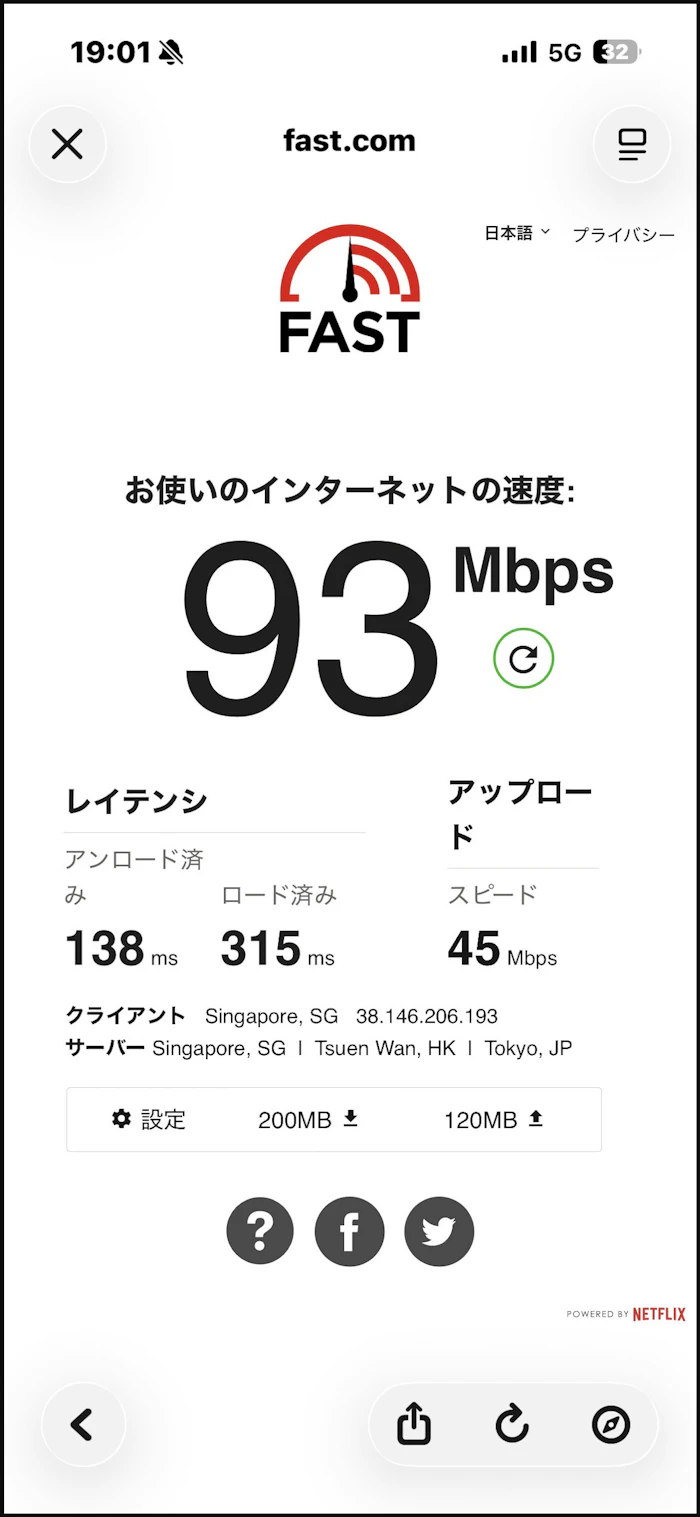
8 | Zhongshan Station | Underground | 19:01 | 5G | 93 | 45 | 138 / 315 |
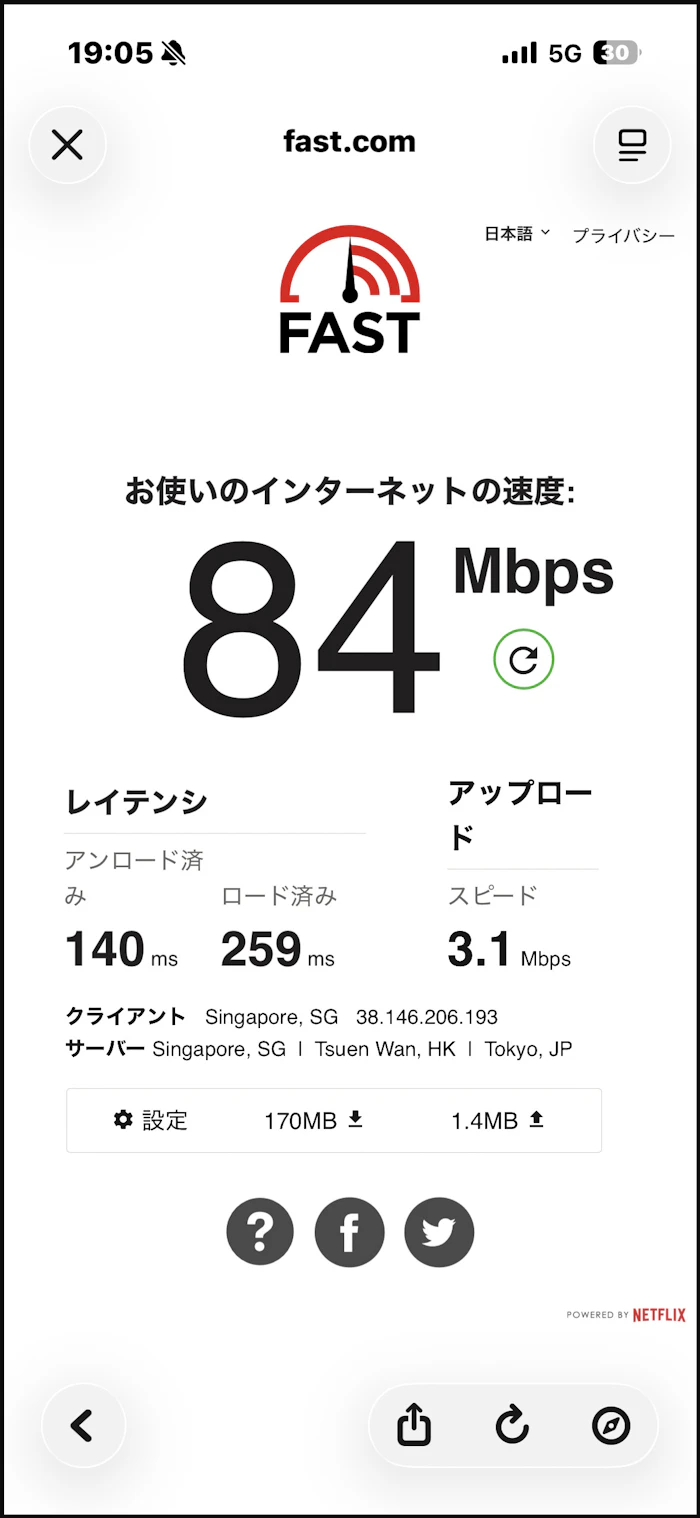
9 | Zhongshan Station | Street level | 19:05 | 5G | 84 | 3.1 | 140 / 259 |
10 | MRT train | In transit, underground | 17:54 | 5G | 12 | 65 | 139 / 508 |
Three things to keep in mind when reading that table:
- Each row is a single run, not an average of repeated tests. Mobile speeds move with the time of day, how many people are on the same cell, and exactly where you are standing.
- The test servers were not in Taiwan. fast.com connected to servers in Singapore, Hong Kong and Tokyo and reported the client as Singapore. That international path is why unloaded latency sits around 130 ms rather than the 20 to 40 ms you would see against a local server.
- Two runs have gaps, and we left them in. At Ximending the upload leg transferred 0 MB, so no upload figure was captured. At Taipei 101 the status bar showed four signal bars with no network-type label, so the network is recorded as unknown rather than assumed to be 5G.
The hotel Wi-Fi run is deliberately excluded from that table, because mixing a Wi-Fi measurement into an eSIM data set distorts the averages. It appears further down as a like-for-like comparison, taken in the same room within one minute of the eSIM test.
How We Ran the Speed Tests
Tested by the Trifa editorial team in Taipei, March 2026. The setup was deliberately simple, so the numbers are easy to interpret and easy to criticize.
Item | Detail |
|---|---|
Measurement tool | fast.com (run by Netflix) |
Device | iPhone, 5G-capable model |
eSIM used | Trifa travel eSIM for Taiwan |
Network connected to | Chunghwa Telecom |
When | March 2026 |
Number of runs | 11 (10 on the eSIM, 1 on hotel Wi-Fi) |
Test servers reported | Singapore, SG | Tsuen Wan, HK | Tokyo, JP |
Metrics recorded | Download, upload, unloaded and loaded latency, network type on the status bar |
fast.com runs a series of downloads from and uploads to Netflix servers and reports the maximum speed your connection provides. It labels its two latency readings "Unloaded" (the round trip on an idle connection) and "Loaded" (the round trip while the connection is saturated). The loaded figure is the one that predicts how a video call or a map reload behaves while something else is downloading in the background. [Source: fast.com, Netflix, accessed 2026-08]
Two limits are worth stating up front. One run per spot means a single unlucky moment shows up as a low number with no second sample to balance it, and the 12 Mbps reading on a moving MRT train is exactly that kind of measurement. And this is one provider on one network with one handset, in Taipei only: it says nothing about Tainan, Hualien or the mountains, and nothing about how a different eSIM brand on a different carrier would perform in the same spots.
One more disclosure: the screenshots below show fast.com in Japanese, because the tester's phone was set to Japanese during the trip. The numbers, units and server names are identical in every language, and we kept the original screenshots rather than re-shooting the tests.
Speed Test Results by Location in Taipei
The same runs, place by place, with the screenshot from each test. Times are local (UTC+8).
Taipei Main Station: underground and street level
Taipei Main Station is where the Taiwan Railway, the High Speed Rail and three MRT lines meet, and it is the first place many travelers try to load a map after arriving from Taoyuan Airport. On the underground concourse at 10:46 we recorded 260 Mbps down and 87 Mbps up on LTE. At street level at 11:01, 200 Mbps down and 43 Mbps up on 5G.
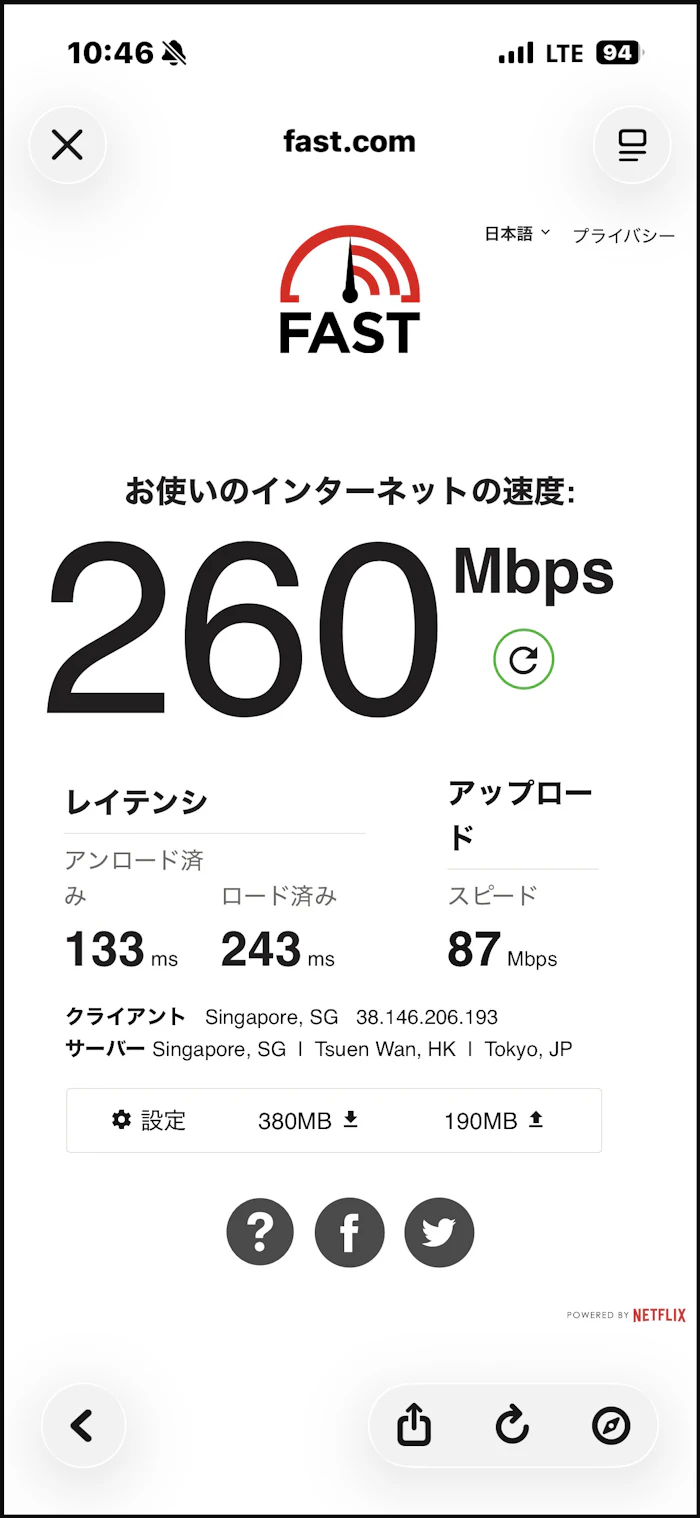
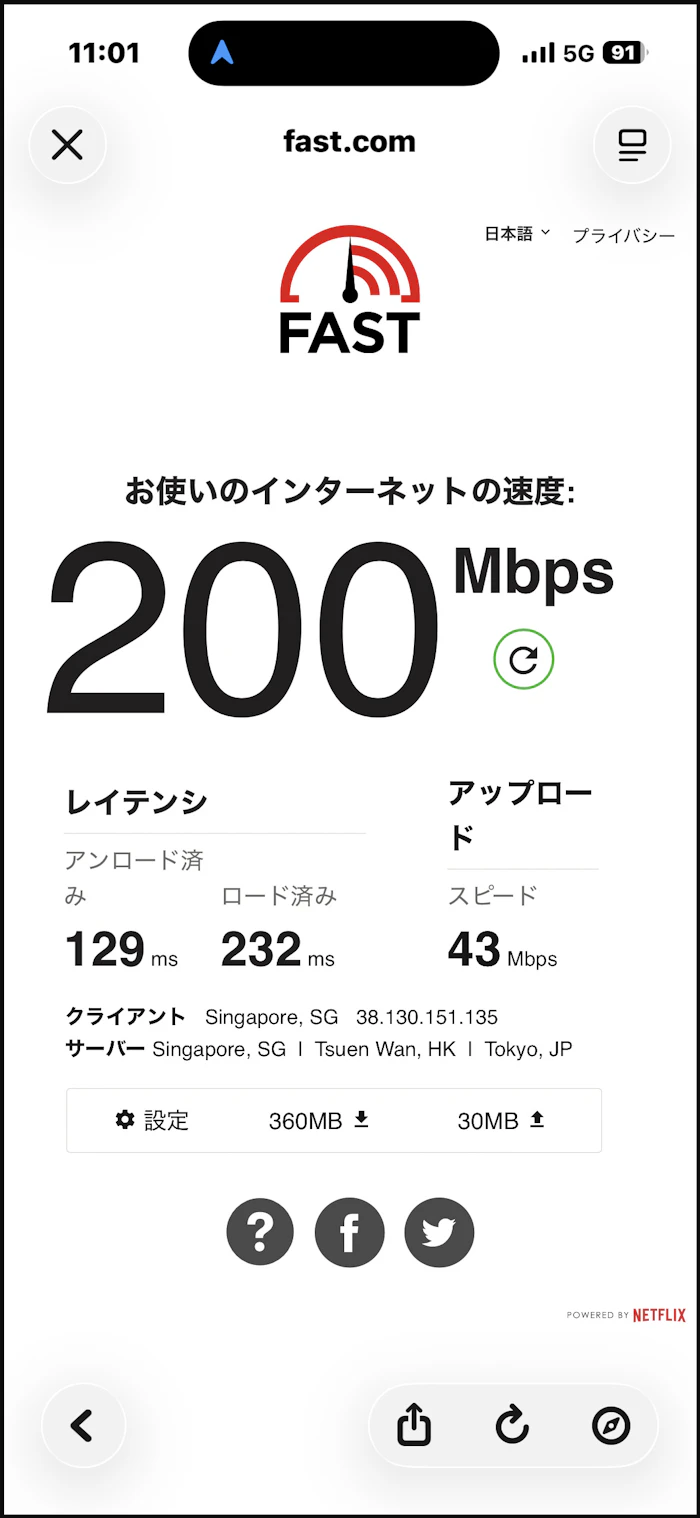
The underground run was the faster of the two. That ordering surprises people who assume 5G always wins, but a lightly loaded LTE cell can beat a busy 5G cell, and 15 minutes is more than enough for cell load to change. Both speeds are far more than you need to check a platform number or pull up a station map.
Ximending and Taipei 101
Ximending is Taipei's pedestrianized shopping district, dense with people at almost any hour. Taipei 101's basement food court is the harder test: an indoor level below ground inside a very tall building.
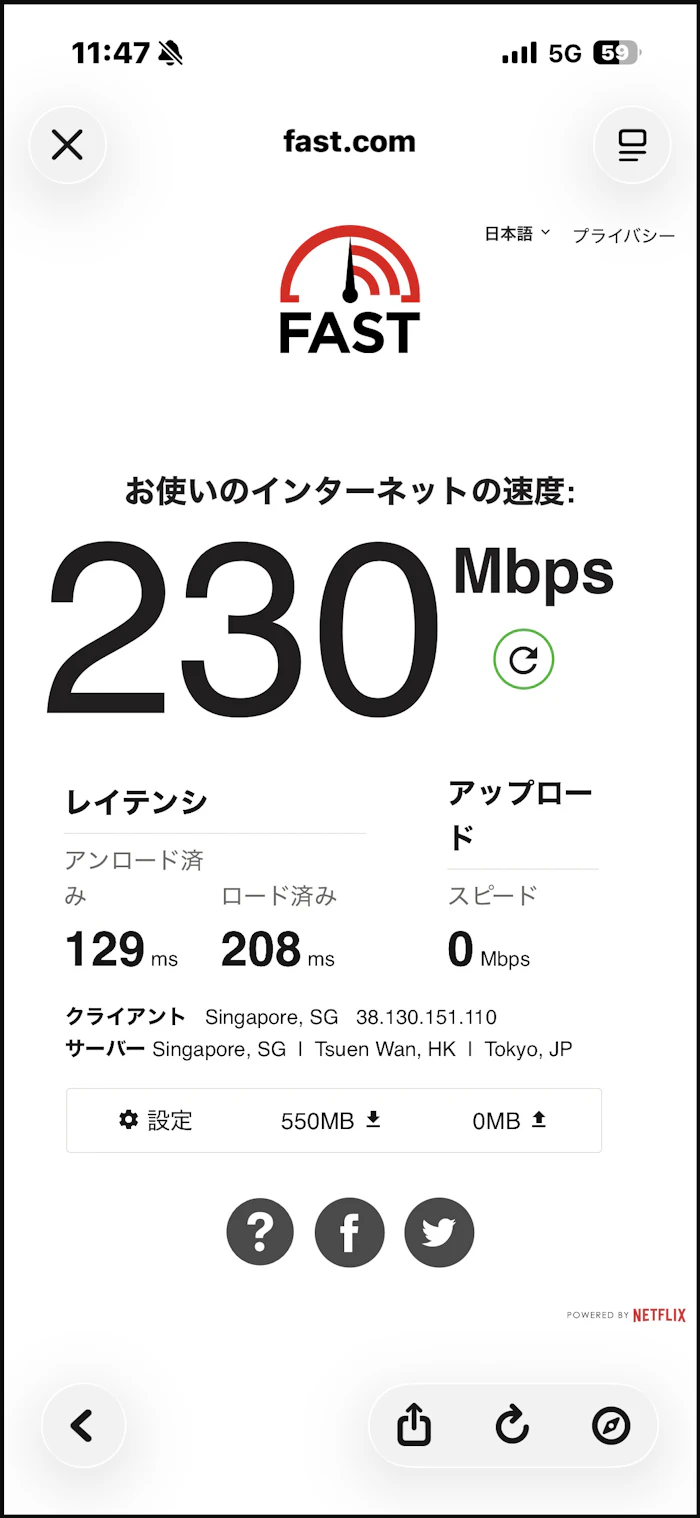
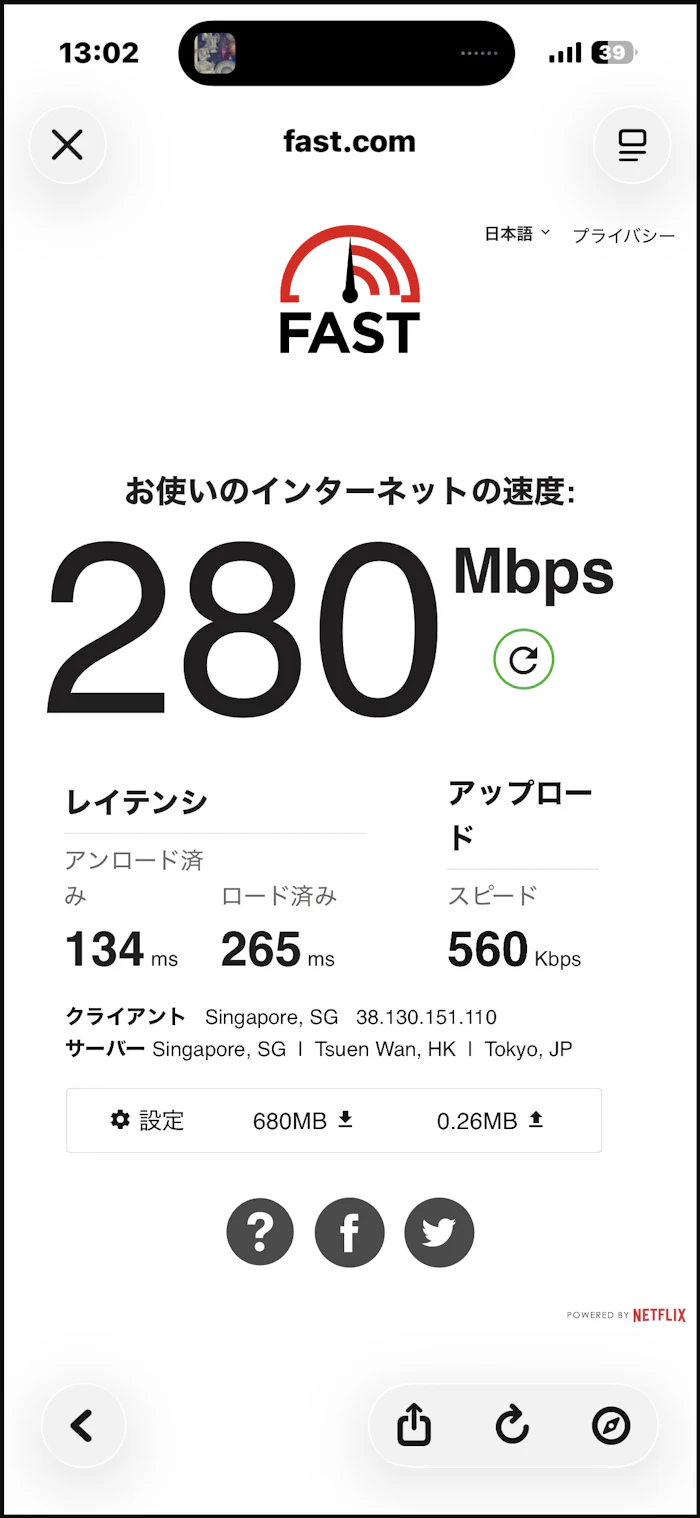
Both runs carry a caveat that is visible in the screenshot. At Ximending the download came in at 230 Mbps on 5G, but the upload leg of that run transferred 0 MB, so fast.com displayed 0 Mbps. We are not treating that as "the upload speed was zero." It is a failed measurement, and the honest label is that no upload value exists for this spot.
At Taipei 101 the download was 280 Mbps, the highest indoor reading of the trip, with 134 ms unloaded and 265 ms loaded latency. The status bar showed four signal bars with no 5G or LTE label, so the network type is recorded as unknown. Upload was 0.56 Mbps (560 kbps) with only 0.26 MB transferred — far below the other runs. Whether that reflects the cell, the building or the test itself is not something a single run can answer.
On board the Taipei MRT
Visitors ask about the MRT more than any other spot, because a subway is where mobile data usually falls apart. We tested twice while the train was moving: once underground at 17:54, once on an elevated stretch at 18:56.
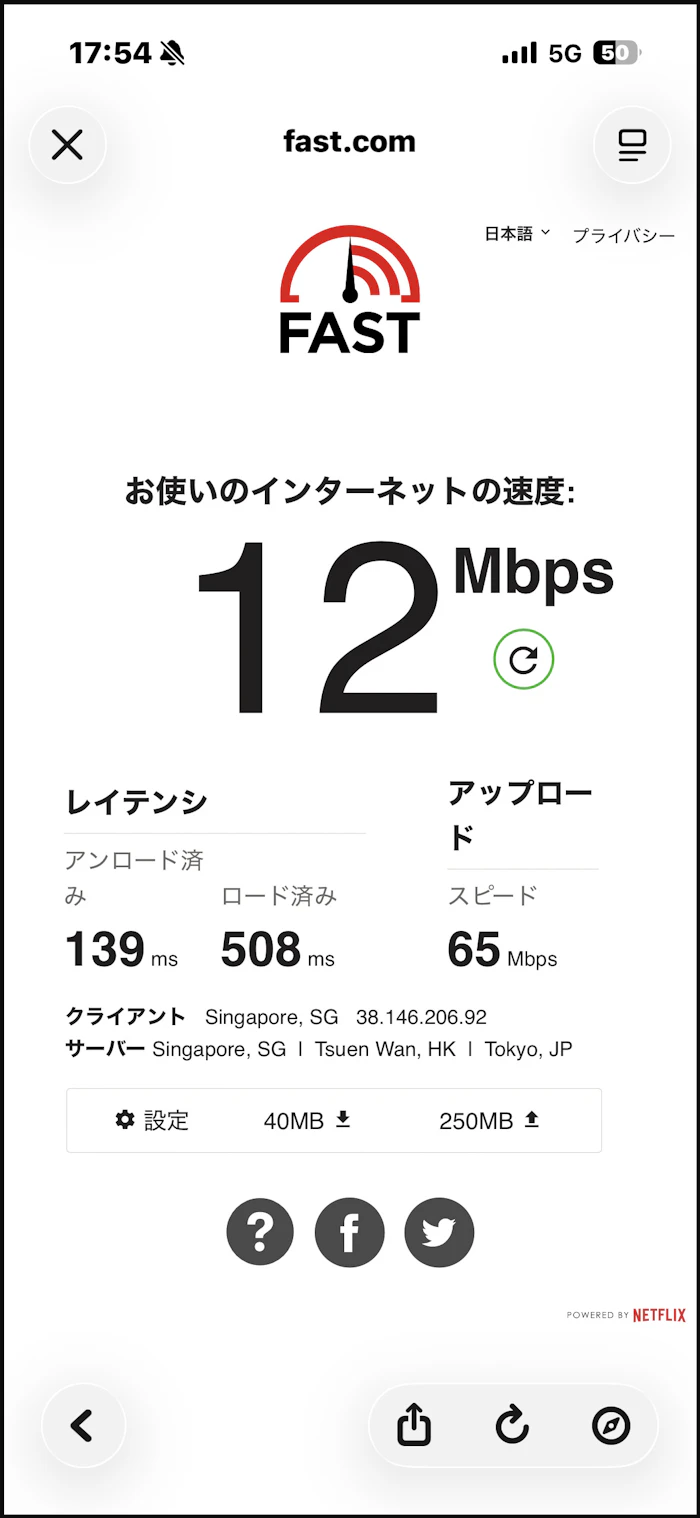
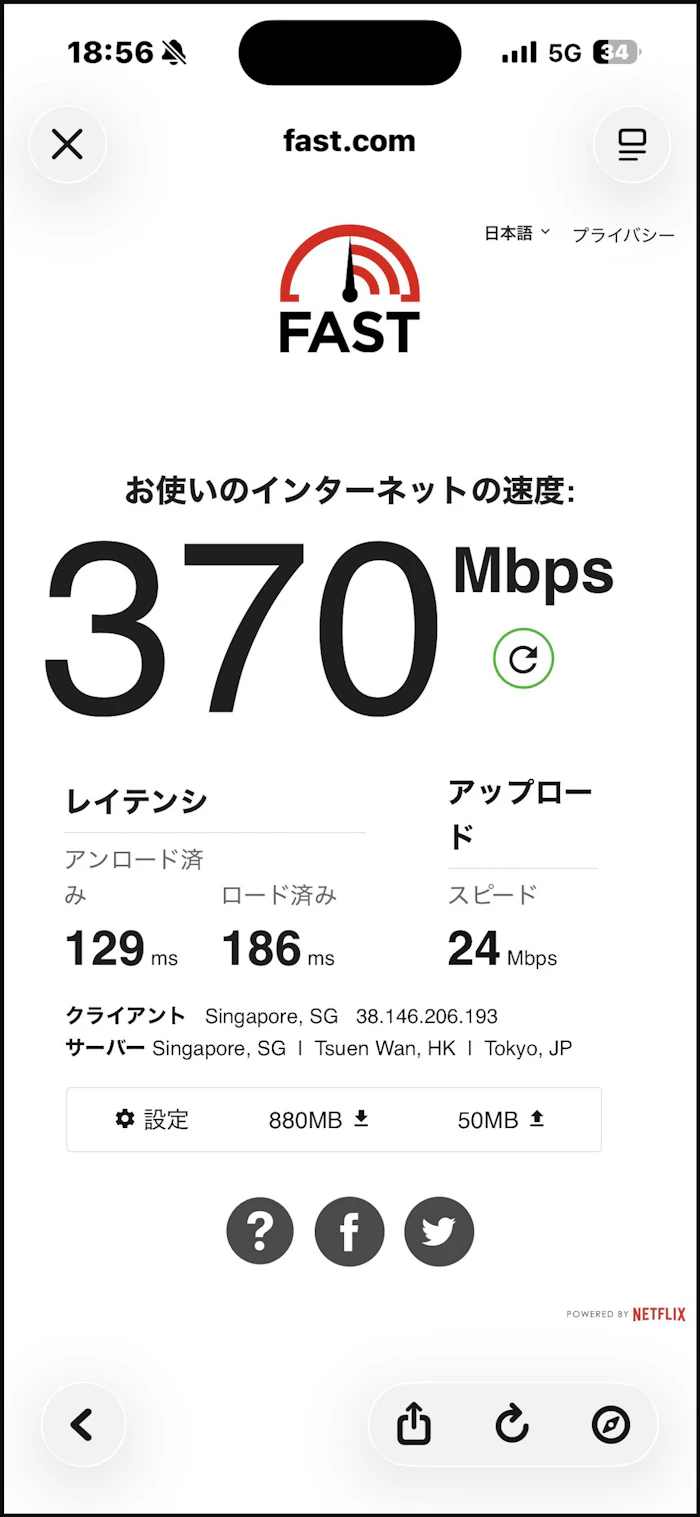
The underground run, at 12 Mbps with 508 ms loaded latency, was the slowest and the highest-latency measurement of the trip. That combination is what a moving train in a tunnel does: the phone hands off between cells repeatedly during the test, and a saturated connection has to re-establish itself each time. It is still enough to send messages, load a station map or stream music, but it is not the number to quote if you want Taiwan's network to look good.
Above ground, the same train produced 370 Mbps. If your mental model is "the MRT is a dead zone," the data does not support it: underground is noticeably degraded, above ground is fast.
Shilin Night Market and Zhongshan
Shilin is Taipei's best-known night market, and the evening crowd is exactly the condition under which people expect mobile data to collapse. Zhongshan is a shopping and dining district with a busy underground station.
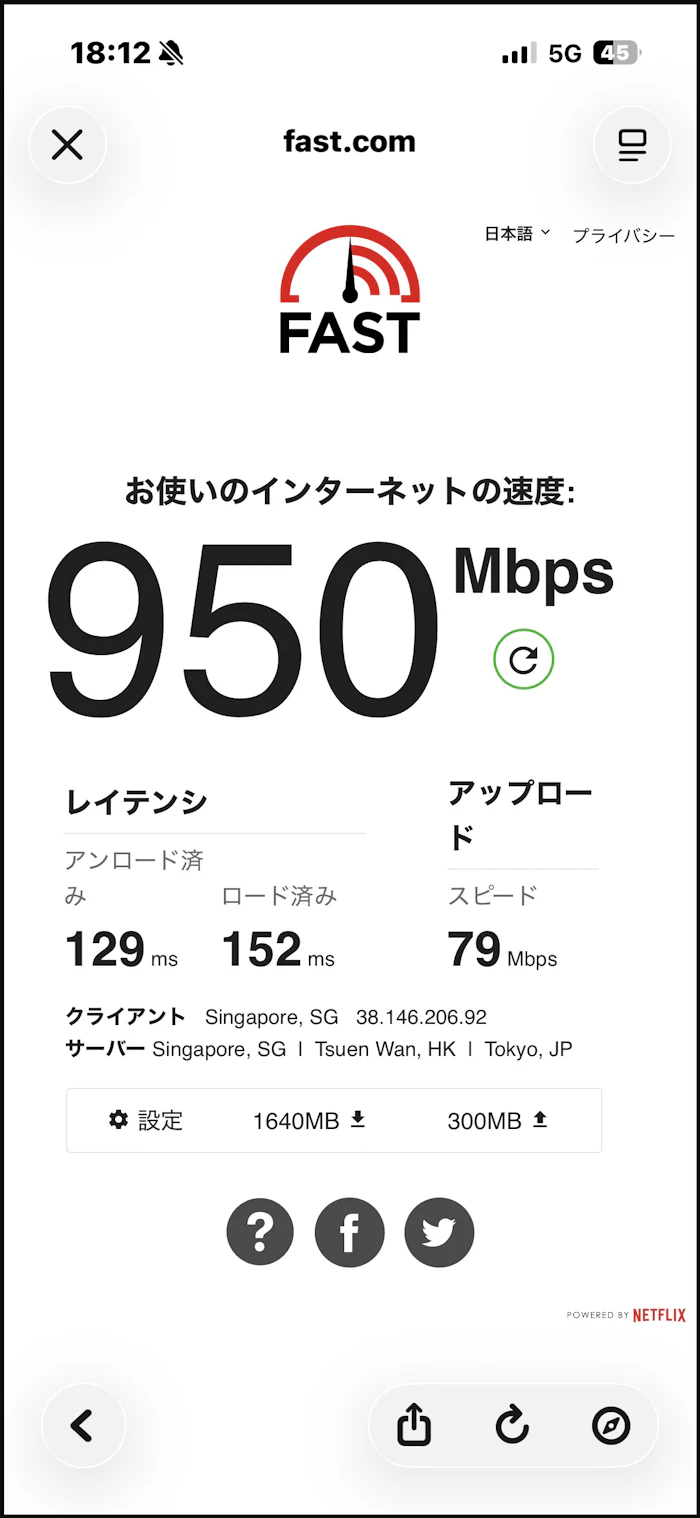
Shilin produced 950 Mbps at 18:12, in the middle of the evening crowd, with the lowest loaded latency of the whole set at 152 ms. That is the most striking number in this data set, and also the one to treat with the most caution: one run, at one spot in a large market, and we cannot tell you it repeats.
Zhongshan came in far lower on both sides of the station, at 93 Mbps underground and 84 Mbps at street level, with uploads of 45 Mbps and 3.1 Mbps. Neither is a problem for travel use, but together with Shilin they show the spread inside a single city on a single evening: 950 Mbps and 84 Mbps, 53 minutes apart.
Hotel room: eSIM against hotel Wi-Fi
The last pair is the one worth reading if you are deciding whether to bother with an eSIM at all. Both tests were run in the same hotel room, one minute apart, on the same phone: first the hotel's Wi-Fi (a HiNet line), then the Trifa eSIM.
Connection | Time | Download | Upload | Latency (unloaded / loaded) |
|---|---|---|---|---|
Trifa eSIM (5G) | 07:28 | 790 Mbps | 91 Mbps | 133 / 179 ms |
Hotel Wi-Fi (HiNet) | 07:27 | 32 Mbps | 25 Mbps | 5 / 345 ms |
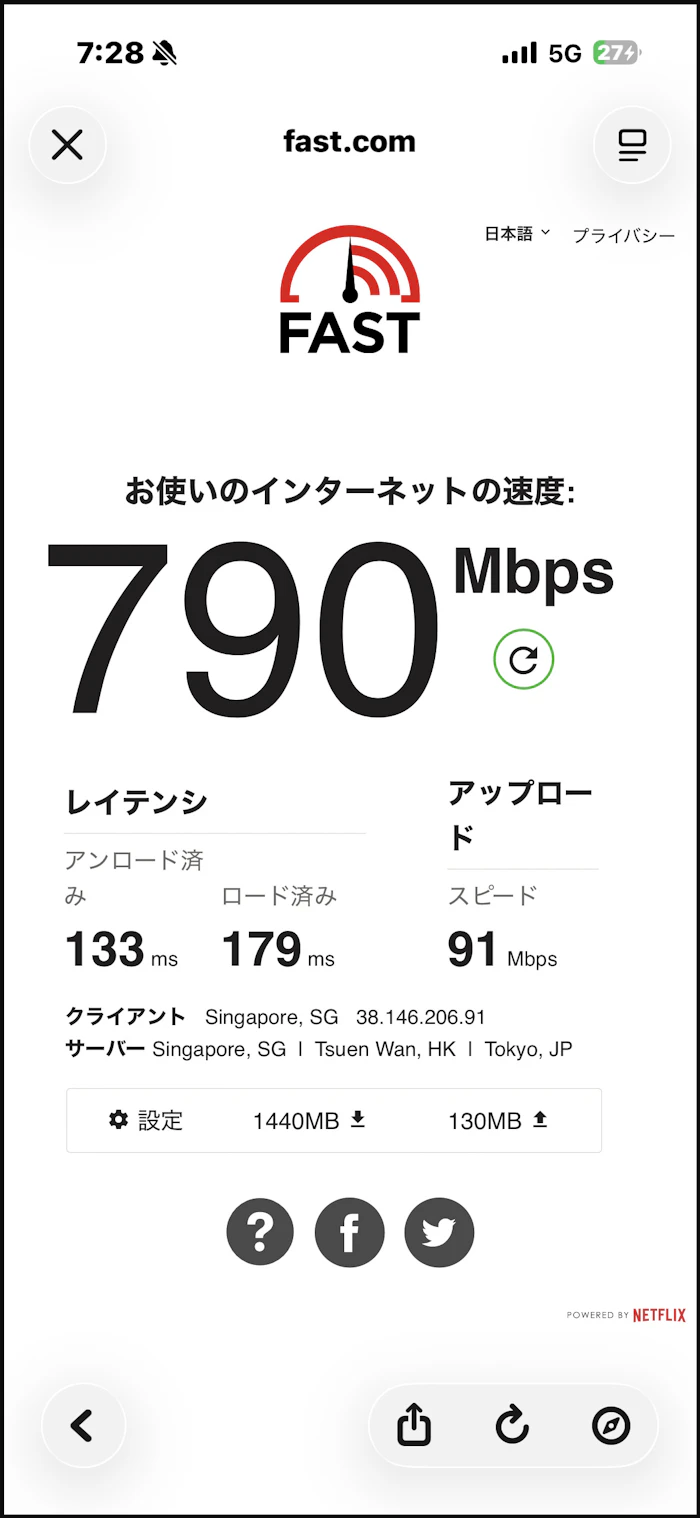
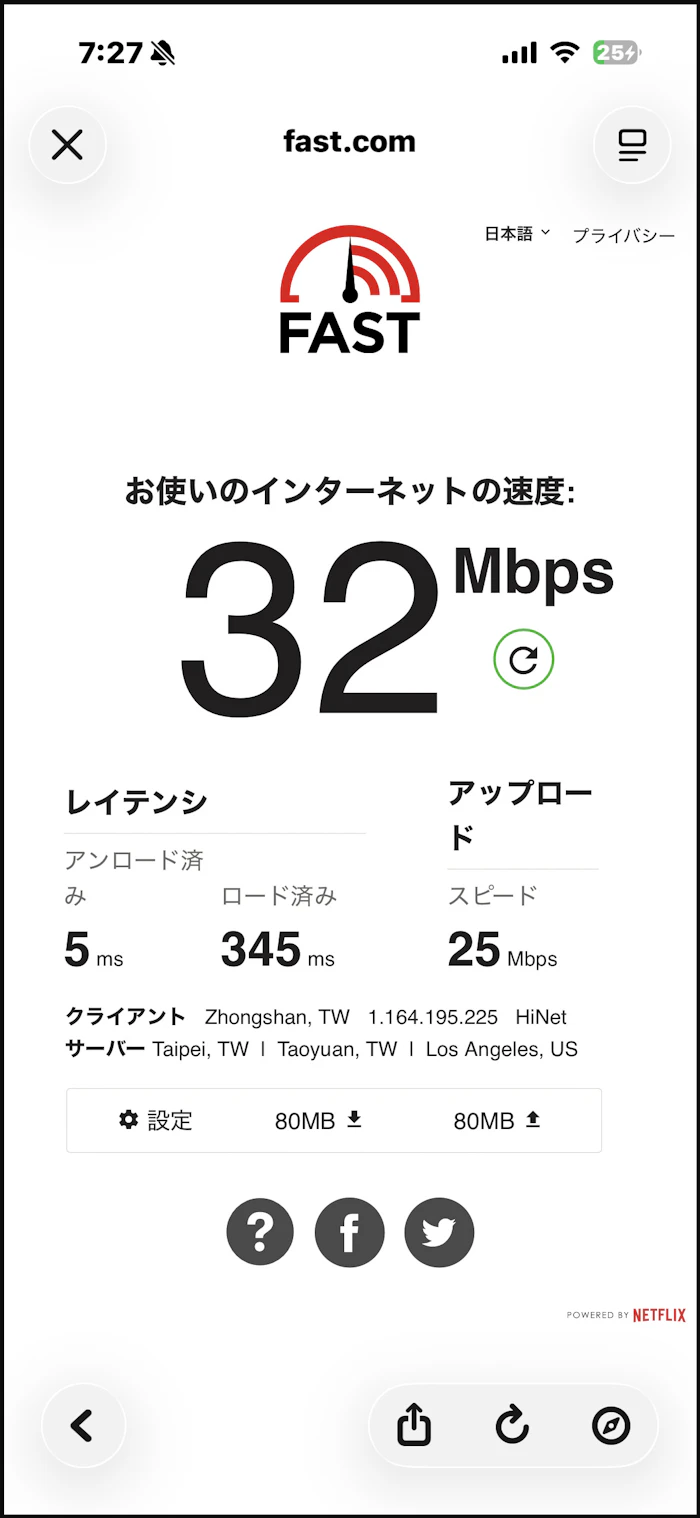
The eSIM downloaded roughly 25 times faster than the room's Wi-Fi, and its loaded latency was about half as bad. The one metric where Wi-Fi won is unloaded latency, at 5 ms against 133 ms, which is exactly what you would expect: the Wi-Fi test terminated nearby, while the eSIM test ran to servers in Singapore, Hong Kong and Tokyo.
This is one hotel, one morning, one room, and a shared hotel line is at its best early in the morning rather than its worst — so it is not a general claim about hotel Wi-Fi. What it does show is that "the hotel has Wi-Fi" is not automatically the faster option, even indoors.
What the Results Say About Taiwan's Mobile Network
Grouping the 10 eSIM runs three ways makes the pattern easier to see.
- 5G against LTE. Eight runs showed 5G, one showed LTE, one was unlabeled. The single LTE run returned 260 Mbps, beating five of the eight 5G runs. On this evidence the network-type label is a poor predictor of the speed you actually get in Taipei; location and cell load matter more.
- Underground and indoors. Four runs were below street level or inside a building: 280 Mbps at Taipei 101's B1 food court, 260 Mbps on the Taipei Main Station concourse, 93 Mbps at Zhongshan Station and 790 Mbps in a hotel room. None dropped to a level a traveler would notice. Being underground in a Taipei station is not, on this data, the connectivity risk it is in some cities.
- Moving. The only run that fell off a cliff was taken while a train moved through a tunnel: 12 Mbps, 508 ms loaded. Standing on a platform or walking through an underground mall is a different situation, and our data covers the riding case only once.
Stated at the strength the evidence supports: across 10 single runs in Taipei in March 2026, a travel eSIM on Chunghwa Telecom returned a median of 245 Mbps, stayed at or above 80 Mbps in 9 of 10 runs, and dipped below that only on a moving underground train. That is a good result from one trip with one setup, not a network-wide benchmark.
How Much Speed Do You Actually Need on a Trip?
Large Mbps numbers are hard to interpret on their own. The useful question is what the apps you will actually open require, and those thresholds are far lower than most people assume.
What you are doing | Speed needed | Source |
|---|---|---|
Video, 4K | 20 Mbps | YouTube official |
Video, 1080p | 5 Mbps | YouTube official |
Video, 720p | 2.5 Mbps | YouTube official |
Video, 480p | 1.1 Mbps | YouTube official |
Video call, 720p | Up to 1.7 Mbps each way | Google Meet official |
Voice call, audio only | About 100 kbps each way | Google Meet official |
[Source: YouTube Help and Google Workspace Admin Help, accessed 2026-08]
Line those thresholds up against the measurements. The slowest run of the entire trip, 12 Mbps on a moving underground train, still clears 1080p video and a 1080p video call with room to spare. Every other run was at least seven times that. In practice the ceiling on your experience in Taipei will be the app, the venue or your battery, not the connection speed.
Latency is the more interesting constraint. Loaded latency in our runs ranged from 152 ms to 508 ms, and that is what you feel when a map redraws while a photo uploads in the background. It is a normal range for a travel eSIM routed internationally, and it is fine for maps, messaging and streaming. Competitive online gaming is the use case where it would bother you.
How much data to buy
Speed and data volume are separate decisions. For volume, Trifa's help center estimates that a single gigabyte covers roughly 3,490 news pages, about 500,000 chat messages, 250 to 500 photos sent or received, about 55 hours of app-based voice calls, or about 1 hour 40 minutes of 480p video. [Source: Trifa official help center, accessed 2026-04]
Read that list and the split is obvious: maps, messaging and browsing consume very little, while video and photo uploads consume nearly all of it. If you plan to navigate and message your way around Taipei for a few days, a small fixed-data plan is usually enough. If you intend to stream, upload video or tether a laptop, buy an unlimited plan and stop thinking about it.
Which Network Does a Taiwan eSIM Connect To?

A travel eSIM is not its own network. It is an agreement to roam onto a local carrier, so the carrier behind the plan is what determines the speeds you get.
Taiwan has three national mobile operators: Chunghwa Telecom (中華電信), Taiwan Mobile (台灣大哥大) and Far EasTone (遠傳電信). The market held five until January 2023, when Taiwan's regulator, the NCC, approved Taiwan Mobile's merger with Taiwan Star and Far EasTone's merger with Asia Pacific Telecom. [Source: Taiwan News, accessed 2026-08]
Chunghwa Telecom describes itself as "the largest integrated telecommunications operator in Taiwan" and reported 13.34 million mobile subscribers as of March 31, 2026, up 1.7% year over year. [Source: Chunghwa Telecom official, accessed 2026-08]
Which network a given eSIM uses varies by brand, and the better providers say so on the product page:
Provider | Taiwan network named on its official page |
|---|---|
Trifa | Chunghwa Telecom |
Nomad | Chunghwa |
Airalo | Taiwan Mobile |
Holafly | Not disclosed on the Taiwan product page |
[Source: each provider's official site, accessed 2026-08]
One quirk worth knowing before you run your own test: during our runs fast.com reported the client location as "Singapore, SG." That is an artifact of how eSIM traffic is routed and where it exits to the public internet, not evidence that you are connected to a Singaporean network. The handset was on Chunghwa Telecom in Taipei throughout. If you see a foreign city listed on a speed test while abroad, this is usually why — and it is also why latency on a travel eSIM reads higher than on a local SIM.
Taiwan eSIM Providers Compared
This article is about measured speed rather than a full shopping comparison, so the table below is deliberately short: the network each provider names, how its plans are structured, and one representative USD price taken from the provider's own site. Prices move, and every one of them should be re-checked at the source before you buy.
Provider | Network named | Plan structure | Example price (official site) |
|---|---|---|---|
Trifa | Chunghwa Telecom | Fixed data tiers from 1 GB up to unlimited, 1 to 60 days | Check current plans in the app |
Airalo | Taiwan Mobile | Fixed data and unlimited | $4.00 for 1 GB / 3 days; $12.50 for unlimited / 3 days |
Holafly | Not disclosed | Unlimited only | $12.50 for unlimited / 3 days |
Nomad | Chunghwa | Fixed data and unlimited | Priced in local currency by region; check the site |
[Source: Airalo official and Holafly official, accessed 2026-08. Nomad's Taiwan page displayed local-currency pricing when checked, so no USD figure is quoted. Trifa's Taiwan pricing varies with plan length and promotions and is shown in the app.]
Two structural points matter more than the exact prices:
- Unlimited is not always the cheaper answer. Airalo's 1 GB / 3-day plan at $4.00 costs about a third of its 3-day unlimited plan. If your usage is maps and messaging, the small plan is the rational buy.
- Carrier roaming is a different order of cost. Verizon's TravelPass is $12 per line per day, with 5 GB of high-speed data per day before dropping to 3G speeds. T-Mobile sells international passes at $10 for 1 day / 2 GB, $50 for 10 days / 15 GB and $75 for 30 days / 30 GB, and includes some high-speed international data on certain plans. [Source: Verizon official and T-Mobile official, accessed 2026-08] For a week in Taipei, a single day of roaming can cost more than an entire multi-day eSIM plan — though check your own plan first, since some US and UK plans already include international data you have paid for.
What to Check Before Buying a Taiwan eSIM
Does the plan actually run on 5G?
Our runs showed 5G on the status bar in 8 of 10 tests, and the fastest readings all came from 5G cells. Not every travel eSIM includes 5G access on every plan, so check the product page rather than assuming. Your handset has to support 5G too: on iPhone that means iPhone 12 or later, and on Android it varies by model.
That said, the one LTE run in this data set returned 260 Mbps. If a plan you like is LTE-only, that alone is not a reason to reject it for ordinary travel use.
Data volume and what happens when it runs out
Providers handle exhaustion differently. Some cut you off; some throttle to a low speed and keep you connected. Unlimited plans frequently include a daily high-speed allowance, after which speeds are reduced for the rest of the day. Whichever you pick, find the specific wording about what happens after the limit, because that sentence is the difference between a slow evening and no connection at all.
Real-name registration (KYC) in Taiwan
Taiwan requires identity verification before telecom service can be provided. The NCC has pointed to the Fraud Crime Prevention Act as the basis for the KYC step carriers must complete before a line can be used. [Source: NCC comments reported by Liberty Times, accessed 2026-08]
What that means in practice depends on how you buy:
- A physical prepaid SIM from a Taiwanese carrier: Chunghwa Telecom's English prepaid pages state that a foreign visitor needs a passport plus a second identity document, such as an entry permit, visa, ARC or international student card. [Source: Chunghwa Telecom official, accessed 2026-08] Bring both; do not plan on a passport alone.
- A travel eSIM: the provider handles registration, and the process varies by brand. Trifa completes Taiwan and Hong Kong verification inside the app by photographing your passport, with no counter visit needed. [Source: Trifa official announcement, accessed 2026-08]
Whatever you choose, start this before you fly. Verification is not always instant, and the arrivals hall is the worst place to discover that.
Device compatibility and when to install
eSIM support is broad now, but not universal. Compatible devices include iPhone XR/XS and later, Pixel 3a and later, Galaxy S20 and later, and Xperia 10 IV and later. iPhones bought in mainland China, Hong Kong or Macau are excluded, since those models ship without eSIM. [Source: Trifa official, accessed 2026-04] If your phone came on a carrier contract, confirm it is unlocked.
Install the profile before you leave home, but note that the plan's clock typically starts when the eSIM first connects to a network in the destination country, not when you install it. Installing early costs nothing; activating early can waste a day.
Why Trifa Works Well for Taiwan Travel
The eSIM used for every measurement in this article was Trifa's Taiwan plan, so here is what it is and what it is not.
Trifa is a Japanese travel eSIM app covering 200 countries and regions, with data plans stepping up from 1 GB to unlimited and validity from a single day to 60 days. In Taiwan the plan connects to Chunghwa Telecom, which is what produced the 245 Mbps median and the 950 Mbps peak documented above. Taiwan's real-name registration is completed inside the app by photographing your passport, so there is no counter visit and no separate registration portal. The app holds a 4.5 out of 5 rating from roughly 16,000 ratings on the Japanese App Store as of August 2026. [Source: Trifa official and App Store, accessed 2026-08]
Two things to know before you decide. Trifa plans are data-only: there is no phone number and no SMS, so plan on messaging and calling apps for contact. And in-app chat support runs 24 hours a day, 365 days a year, but the team is staffed by Japanese-speaking agents. English-only travelers can still reach support and use a translation tool, and responses are fast, but we would rather say that plainly than imply an English desk that does not exist.
If that trade is acceptable, the Taiwan plan does what the data in this article shows: a fast Chunghwa connection, set up before departure, working from the moment you land. Current plans and pricing are in the app, and the service is at trifa.co.
Frequently Asked Questions
How fast is mobile data in Taiwan?
In our March 2026 tests around Taipei, a travel eSIM on Chunghwa Telecom returned a median of 245 Mbps across 10 single runs, with a mean of 327 Mbps and a range of 12 to 950 Mbps. Nine of the 10 runs were at or above 80 Mbps. Those figures come from one device on one network in one city, so treat them as a well-documented sample rather than a national benchmark.
Which eSIM is best for Taiwan?
We measured only one, so we will not rank the field on evidence we do not have. What the data does support is a decision rule: check which Taiwanese carrier the plan connects to, whether 5G is included, what happens when the allowance runs out, and how the provider handles real-name registration. Providers that publish their network — Trifa and Nomad on Chunghwa, Airalo on Taiwan Mobile — make that check possible; those that do not leave you guessing.
Does an eSIM work on the Taipei MRT and underground?
Yes, with one qualification. On concourses below ground we recorded 260 Mbps at Taipei Main Station and 93 Mbps at Zhongshan Station, plus 280 Mbps in the Taipei 101 basement food court. Aboard a moving train in a tunnel, the same eSIM dropped to 12 Mbps with 508 ms loaded latency — still enough for messages, maps and music, but you will notice it if you stream video between stations.
Do I need to register my passport for a Taiwan eSIM?
Yes. Taiwan requires identity verification before telecom service is provided. If you buy a physical prepaid SIM from a Taiwanese carrier, Chunghwa Telecom's own pages state that visitors need a passport plus a second document such as a visa, entry permit or ARC. If you buy a travel eSIM, the provider runs the process; Trifa, for example, completes it in the app from a passport photo. Start it before you fly rather than at the airport.
Can I use my US, UK or Australian phone with a Taiwan eSIM?
If it is unlocked and eSIM-capable, yes. That covers iPhone XR/XS and later and most flagship Androids from around 2020 onward, including Pixel 3a and later and Galaxy S20 and later. iPhones sold in mainland China, Hong Kong or Macau have no eSIM hardware. Your home number stays on your existing SIM or eSIM, and the Taiwan plan runs alongside it as a data line.
Is a Taiwan eSIM faster than hotel Wi-Fi?
In our single side-by-side test it was, by a wide margin: 790 Mbps on the eSIM against 32 Mbps on the hotel's HiNet Wi-Fi, run one minute apart in the same room. The Wi-Fi did win on unloaded latency, 5 ms against 133 ms, because the eSIM's traffic was routed internationally. One hotel on one morning is not a general rule, but it is a reason not to assume the room's Wi-Fi is the better option.
Can one eSIM cover both Taiwan and Japan?
Several providers, including Trifa, sell regional Asia plans that cover multiple countries on one profile, which suits a Taiwan and Japan itinerary. The trade-off is that regional plans usually cost more per gigabyte than a single-country plan and may connect to a different local carrier. If Taiwan is the bulk of the trip, compare a Taiwan plan plus a Japan plan against the regional option before buying.
Get trifa and enjoy internet connectivity wherever you go
Only 3 minutes for setup!Get trifa App for FREE!
CHAT BOT
Ask for inquiries about use



Writer
trifa Editorial Team (Travel Prep & Local Info)
We provide easy-to-understand guides for beginners on travel preparation and local information, including the best season to visit, what to pack, and what to be aware of while traveling abroad. When needed, we interview Trifa’s local staff and organize the content based on on-the-ground conditions. We also verify time-sensitive information—such as seasons, regulations, and business hours—using primary sources from public agencies, transportation operators, and official facilities, and we update articles when changes occur (the “Last updated” date is shown in each article).
Search by Category
Popular Articles
POPULAR ARTICLES
01
 Overseas Internet
eSIM is recommended for international travel! Here are 7 advantages in a nutshell.
2024.01.07
02
%2520(1).jpg&w=3840&q=75) Overseas Internet
Overseas InternetWhat are the 6 ways to use a Japanese smartphone/cell phone overseas?
2024.02.06
03
%2520(1).jpg&w=3840&q=75) Overseas Travel Essentials
Overseas Travel EssentialsAre you ready for a trip to Korea? Checklist of things to bring and essentials
2024.02.07
Get trifa and enjoy internet connectivity wherever you go
Only 3 minutes for setup!Get trifa App for FREE!
CHAT BOT
Ask for inquiries about use